10 October 2026 · 8 minute read
Which RVs to Stay Away From?
- Almost every line has a recall. 300 of the 392 RV lines we track had at least one filed with NHTSA since 2016.
- About one recall in three names fire as the risk. More than half name a crash.
- Wiring, wrong weight labels, the frame and body, and propane lines lead the list.
- A free VIN search on the NHTSA site shows open recalls in about a minute.
- In one dealer's 2026 count, new motorhomes in a single gas Class A group needed 8 to 24 hours of tech work before they were ready to sell.
No reliable list of bad RV brands exists. Stay away from the one unit that fails these checks. Open recalls, water damage, propane, tires and labels.

Quick Answer
Stay away from the RV that fails the checks below, whatever badge is on the front. A rig with an open safety recall, a soft floor, a propane leak or tires older than the kids is the one to walk from.
We book RVs from yards all over the country, and we keep every federal recall for the lines we track on our own manual pages. So we read a lot of recall notices. The pattern in them is clear. Recalls follow the systems, not the logo.
Get RV Travel Agency posts first in Google
Why a Brand List Is the Wrong Answer
Search this question in October 2026 and you get videos, forum threads and an AI summary built from them. Most of it names the biggest builders as the ones to avoid. The trouble is that the biggest builders also make the most RVs, so they file the most recalls and collect the most angry posts. Volume looks like bad quality when you count it that way.
The other trouble is that quality changes from one unit to the next. A well kept trailer from a builder with a rough name beats a soaked one from a builder with a good name. Water does not care about the badge.
There is also a lot of used stock out there from the boom. RV makers shipped a record 600,240 units in 2021, up from 430,412 in 2020, by the count of the RV Industry Association. Those rigs are now four and five years old. When you shop used, their history matters far more than their brand. See the shipment report.
One dealer shows how wide the gap is inside a single class of RV. National Indoor RV Centers posts the work it takes to get each maker's new motorhomes ready to sell. On its page for 2026, read in October 2026, makers in one gas Class A group ranged from 8 to 24 hours of tech time per unit. Major defects, the kind that take two hours or more, ran from none to 3.2 per unit across all its groups. The dealer itself says quality is only one part of the choice, and not a reason on its own to skip a brand. See its numbers.
What 1,232 Recalls Say About Where RVs Fail
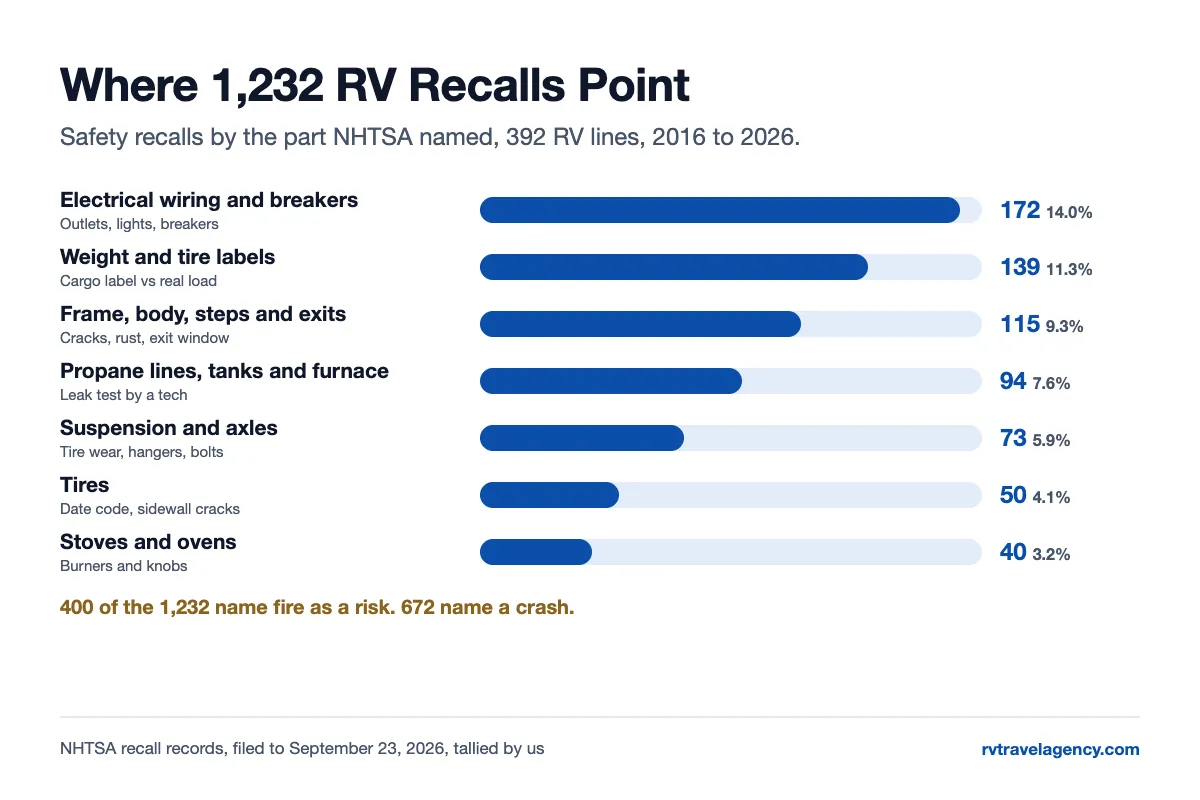
We tallied the safety recalls NHTSA has on file for the 392 RV lines in our free RV manuals. That is 1,232 separate recall campaigns filed from January 2016 to September 23, 2026, pulled from NHTSA in September 2026. The table groups them by the part NHTSA named. It tells you where to look hardest on any RV, new or used.
| Area NHTSA named | Recalls | Share | What to check |
|---|---|---|---|
| Electrical wiring and breakers | 172 | 14.0% | Every outlet, light and breaker works. No hot or melted plugs. |
| Weight and tire labels | 139 | 11.3% | The cargo label matches the tanks and the load you plan to carry. |
| Frame, body, steps and exits | 115 | 9.3% | No cracks or rust at the frame. The exit window opens all the way. |
| Propane lines, tanks and furnace | 94 | 7.6% | A tech runs a leak test. No smell of gas at the stove or furnace. |
| Suspension and axles | 73 | 5.9% | Even tire wear. No bent hangers or loose bolts under the frame. |
| Tires | 50 | 4.1% | Date code on each tire. No cracks in the sidewall. |
| Stoves and ovens | 40 | 3.2% | Burners light clean and the knobs shut fully off. |
Two numbers stood out. 400 of the 1,232 recalls name fire as a possible result. 672 name a crash. These are not small fixes.
The labels line surprises people. A wrong cargo label means you can load the rig past what the axles and tires were built to carry and never know it. It is the quiet recall that leads to the loud failure on the highway.
Run the VIN Before You Do Anything Else
Every RV has a 17 character VIN. Put it into the NHTSA recall search and it tells you if that exact rig has a safety recall that was never repaired. Makers must fix a safety recall by repair, replacement or refund, so an open one is a free fix you should get done before you sign.
Know what the search will not show. NHTSA says it leaves out recalls older than 15 years, recalls from small manufacturers and some new recalls where not every VIN is loaded yet. Plenty of RV builders are small. So also call the maker with the VIN, and look up the line on our RV manual pages, which list every recall NHTSA has filed for each line we track.
The same NHTSA page lets you search owner complaints by keyword. Complaints are not proof of a defect. But if many owners report the same leak or the same failure on the same model, NHTSA says that pattern is what can lead to an investigation and a recall. Read them for the model year you are looking at.
Stay Away From Any RV That Fails These Checks
Do these on any RV you are about to buy. Most take a flashlight and an hour. A few need a trained tech, and those are worth paying for.
Water damage first. Push on the floor near every door, window and the bathroom. Press the walls under windows and around roof vents. A soft spot, a bubble in the outside skin or a brown stain on the ceiling means water got in. That repair can mean pulling floors and walls. Our roof and seals manual shows where leaks start.
Propane next. Ask a tech for a leak and pressure test. Smell for gas at the stove, furnace and water heater. Propane system parts were 94 of the recalls in our tally. See the propane system manual for how the parts fit.
Tires by date, not tread. NHTSA says tire aging is a real risk for RVs because they sit, and that some makers say to replace tires six to 10 years old no matter the tread. The last four digits of the DOT code on the sidewall give the week and year it was made. A code of 0319 means the third week of 2019.
Weight and labels. Find the cargo carrying capacity label by the door. Add full water, propane, people and gear. If that beats the label, the rig is the wrong size for you.
Slides, power and exits. Run each slide out in and out twice. Test every outlet, light and appliance on shore power and on the battery. Open the emergency exit window all the way. Exits and steps were recalled more than 30 times in our tally.
The seal by the door. RVs from builders in the RV Industry Association carry its seal. The group says it runs more than 2,000 unannounced plant checks a year against over 500 safety rules, and that most campgrounds ask for the seal. No seal is not a deal breaker on its own. It is a reason to ask more questions.
When to Walk Away
Some findings end the deal. Some just change the price. We draw the line below.
- Walk if the seller will not let a tech of your choice inspect it.
- Walk if the floor or a wall near a window is soft and the price does not cover a full rebuild.
- Walk if there is any gas smell, or the leak test fails, until it is repaired and tested again.
- Walk if the VIN on the rig does not match the title.
- Push for a fix if a recall is open. It is free from the maker, so get it done before you take the keys.
- Use old tires as a price cut. A full set on a trailer is a cost you will pay soon anyway.
What People Get Backwards
Most advice on this question is a ranked list of builders with no data behind it. The lists rarely say which model year, which floor plan or which part failed. They pass along a feeling, and a feeling will not find a soft floor.
The better habit is boring and it works. Pick the floor plan that fits how you camp. Then judge the one unit in front of you on its recalls, its water history, its propane, its tires and its labels. That is how you stay away from a bad RV.
Still torn between two floor plans? Rent the one you like from our RV fleet for a weekend first, or browse campgrounds to see what a real trip in it would look like.
What Folks Ask
Which RVs to stay away from?
Stay away from the unit that fails a basic check. That means an open safety recall that the seller will not fix, a soft floor or wall from water, a propane leak, tires older than about six to 10 years, or a load that beats the cargo label. Those problems cost far more than any brand gap.
What RV brand has the least problems?
No public data ranks every brand fairly. Recall counts grow with how many RVs a builder makes, and dealer defect numbers come from one dealer's mix. Judge the floor plan and the single unit in front of you, and check its VIN for open recalls.
What to avoid when buying an RV?
Avoid buying without a VIN recall search, without pressing on floors and walls for water damage, without a propane leak test, and without reading the tire date codes. Avoid any seller who will not allow an outside inspection.
How do I check if an RV has a recall?
Enter the 17 character VIN on the NHTSA recall site. It shows safety recalls not yet repaired on that exact rig. It may miss recalls older than 15 years and recalls from small builders, so also call the maker with the VIN.
Do RV recalls cost anything to fix?
No. Under federal rules the maker has to fix a safety recall by repair, replacement or refund, at no cost to the owner. Get any open recall done before you buy, or make the sale depend on it.
How old is too old for RV tires?
NHTSA says some vehicle and tire makers advise replacing tires six to 10 years old no matter how much tread is left. RVs sit a lot, which ages tires faster. Read the last four digits of the DOT code to see the week and year each tire was made.
Backing for the Numbers
| What we cited | Where it came from |
|---|---|
| VIN search, what it leaves out, complaints and how a recall starts. | NHTSA, Check for Recalls |
| 1,232 campaigns filed January 2016 to September 23, 2026, tallied by us. | NHTSA recall records for 392 RV lines |
| RVs and tire aging, the six to 10 year advice and how to read the DOT date code. | NHTSA, Tires and tire aging |
| The seal, unannounced plant inspections and safety rules. | RV Industry Association, Standards |
| 600,240 units in 2021 and 430,412 in 2020. | RV Industry Association, 2021 shipments |
| 2026 figures. | National Indoor RV Centers, Manufacturer Defects Per Unit |
Written by The yard team. Call or text (909) 259-7837 if you want to rent the same floor plan for a weekend before you buy one.